Positivt tänkande med support – det är bra!

I’m a 34-year-old corporate attorney in San Francisco. I started my own practice about a year and a half ago–a tremendous leap of faith for me, in part because of speech issues I’ve dealt with since I first started to talk. In the beginning I used all kinds of tricks to try to be fluent in situations where I’d stutter, especially on the phone, but I’m proud to say that I never think about speech issues anymore in my work. I actually truly enjoy talking on the phone for work now–it’s more fun than meticulously revising legal documents!

Public speaking has also become a joy. Last week I gave an impromptu, surprise talk to a roomful of applicants to my law school (the organizer called on me to stand up, introduce myself, and talk, with no prior warning), had no speech problems, and several applicants came up to me afterwards to ask me more about what I’d said. I’m going to be leading a multi-hour workshop in a couple weeks for the management teams of between 10 to 30 potential corporate clients, and I’m excited at the opportunity to meet them, help them with their legal issues, and hopefully sign up some of them as clients.

It sounds like you’re well on your way on the path to fluency. Keep pushing yourself beyond your comfort boundaries, even if there are temporary setbacks–over time, fluency will become something you forget to worry about. And don’t sell yourself short–you should be practicing law and giving clients the benefit of your knowledge and experience, not hiding as a paralegal!!

Let me know if you have any questions or want to chat on the phone or over Skype. I’m happy to see another attorney on the same path that I’ve taken.
Jared
Hur gör jag för att komma åt en traumatiserande händelse?

Ahsen,
With these words: “With my mother I watched my words, fearing of disappointing because she was the first to reproach my stuttering,” you no doubt have hit the target right on the bull’s eye as to why you stutter in front of your mother.

And, with these words, “she has never criticized my stuttering. Instead , she made ​​me compliments about my physique,” you have hit the bull’s eye on the target for why you do not stutter in front of your sister”.

(Now, since you have spoken of your beautiful physique, you will need to insert it in an email so we all can see it.) 🙂

So, you have two parts of you that are at odds with each other:

1.Part that fears stuttering in front of your mother

2.Part that is fluent in front of your sister and desires to be fluent with your mother

These two parts are literally fighting against each other to “win”.

Fear of stuttering in front of mother (low self-esteeming) ß—————-àSpeaking fluent in front of sister (high self-esteeming)

These two parts fighting against each other literally “freezes” the mind leading to blocking. It is like driving down the road at 100 mph with your breaks on.

What would happen if you layered the high self-esteeming mental state with your sister on top of and through the low self-esteeming part of speaking with mother? This is a merging of those pictures and/or those feelings together. Which state would win?

How old were you when your mother first criticized you about stuttering?

Get a visual image of the younger you, the boy, that was overwhelmed with hurt when mother criticized him for stuttering.

Now, once you have that image and you can see the younger you, ask yourself, “What does that younger me need?” Once you have an answer, image the adult you going to that younger you providing him with what he needs.

If needed, you can image your mother giving that younger you what he needs. For, surely, your mother did not mean for you to become a stutterer – she meant the opposite. It was just that younger you, that boy, did not have the mental resources that he needed at that time to proper interpret mother’s intention. Forgive your mother; forgive yourself for misinterpreting and let your mother, mother that younger you.

Experiment with the above and let us know what happens.

Note: Give yourself a week of practicing this. And, “only” practice this when you are by yourself. Do not practice it when in front of family and friends. Doing so will most likely increase your stuttering because you mind will be on stuttering and that will cause you to stutter. Experiment with this as well. Use what works for you and discard the rest.

Good luck.

Bob
(klipp från neurosemanticsofstuttering@yahoogroups.com)

Stamningsepisoder eller blockeringar av talet

”…What you want to find out is the “meaning” you place on speaking with family and friends.
1. Ask yourself, “Luis, when you are around strangers, you are fluent; however, when you are around family and friends you stutter. What is the difference in meaning that you give to these two different situations?
And/or:
2. “What ‘meaning’ do I place on my family and friends that creates anxiety and fear in me that I do not have when speaking with a stranger?”
3. “How old do I feel when I am around family and friends and I am stuttering?”

Go inside and ask yourself these questions. It would be great if you have your wife ask you these questions so that you can focus on going inside and analyze what is going on inside your mind-body that is triggering your speech strategy for stuttering?

Let us know what answers you come up with.
Thanks
Bob”
(klipp från neurosematicofstuttering)
+++++++++++++++++++++++++
Bobby G. Bodenhamer, D.Min.
1516 Cecelia Dr.
Gastonia, NC 28054
704.864.3585 – Business
704.864.1545 – Fax
bobbybodenhamer@yahoo.com
http://www.renewingyourmind.com
http://www.masteringstuttering.com
http://www.neurosemantics.com
++++++++++++++++++++++++

Han säger att alla kan bli professionella talare!

Hi All,
Further to my earlier post, I’ve since come across the following YouTube extract in which Ed Tate discusses his childhood stuttering:

I did, in fact, chat with him (in private) about my own experiences at the conclusion of the public speaking workshop in the UK yesterday.
Kindest regards
Alan

Så bra kan jag vara mot mitt barn som stammar!

That’s one of the best pieces of advice for parents that I’ve ever read, Anna.
Just brilliant.
John

Sharif,
> I have three kids and all of them had some disfluences which were noticeable enough to make my mother alarmed. Two daughters grew up without stuttering. My son is 5 now, but i think he is not in any danger now.
I am not qualified to give you a professional advice.

But my personal beliefs are
1) Refrain from any comments on a child’s language. If a child mispronounces
a word, simply start using this word more and speak it slower and more clear but without making it obvious. If a child speeds up and is difficult to understand – first pace the speed (speak in the same speed) then slowly slow your speech down a bit. If a child is disrespectful, says dirty words – don’t react emotionally but use different time to have a talk about bad words. Etc. The goal is to avoid creating language anxiety and worries about speech. 2) Listen very carefully, pay attention, be genuine. Trying to get an adult attention is very stressful for sensitive children. If they worry you won’t listen, they may get nervous and whatever difficulties they have, may get aggravated. 3) Make it ok for you to have a child who stutters. Be certain that with your support and knowledge her experience with stuttering will be very different from yours. 80% of kids recover by the time they start school. Kids are very sensitive to body language and emotional energy. If you get nervous every time she blocks, she will sense it. If your heart breaks every time she blocks, she will sense it.

When my son had disfluences around age 3.5-4 I followed those steps and made
it ok for me if he stutters. I knew that stuttering or not we will help him to
grow happy and confident. Now his speech is not different from other kids his
age. He stumbles when he is excited, but so do other kids as far as I can hear.
So it is not an expert advice, but may be you will find something for you in my
experience.
> Anna

När stamningen minskar och försvinner

”…I’m with John, let’s sto p putting the focus on studying PWS; and let’s put the focus on Ruth, John, Alan, Linda, David, etc. and discover “how” they were able to defeat stuttering in their lives. That is what NLP and NS are all about – modeling behavior the good and the bad. We ask, “How are you doing that? What are you doing in your mind in order to do that? Do you always do that? If not, than how do you explain that? Etc….”
(Bob Bodenhamer)

Hur fångas din uppmärksamhet?

”…What i want is to create short -10 min audio-talks about different approaches I used in my journey. The problem is the focus. What grabs your attention? What makes you want to learn more?”
Anna

Vad är det som intresserar just dig? Det är vad min fråga ska vara. Inte tro, att just mina erfarenheter är de rätta för alla andra i samma situation. Annas fråga är angelägen: ”Vad är det som får dig att vilja lära dig mera?”

Skådespelaren lär in sin personroll, stammaren sin stamningsroll…

”Could it be that when a PWS mimics someone else’s speech who doesn’t stutter, the PWS is “putting on” that person’s mindset as well. The PWS imagines herself in the body of the fluent person that she is mimicking. So, she is in essence “stepping out” of her stuttering self and is “stepping into” a “fluent” self without all the baggage that comes from being a PWS.

In my opinion, mimicking someone who doesn’t stutter has much more to do with thinking than does it have to do with physiology though for sure both are involved.

As you so say, “It is something to think about.”
(Bob Bodenhamer)

Vad kan man mena med stamning?

”…Blocking usually, if not all the time, presupposes fear for fear triggers stuttering. But, when one is esteeming themselves highly and when a person is self-confident, they have the resources to say “no” to fear and thus they are saying “no” to stuttering and “yes” to fluency.”
(Bob Bodenhamer)

Vi kan lära av varandra…

I truly believe that we can all learn something (however small) from each other. Being able to interact (and share our experiences) with persons around the world has allowed us to acquire a far greater understanding of the issues that shape our lives.

As a result of the varied discussions that take place on online forums (and the availability of other material which is disseminated via the Internet), many are now better equipped to deal with their stuttering/blocking.

But, perhaps, most importantly, we know that (unlike those of us who grew up in the pre-Internet era) we need never again experience the isolation of facing those challenges alone.
Kindest regards
Alan

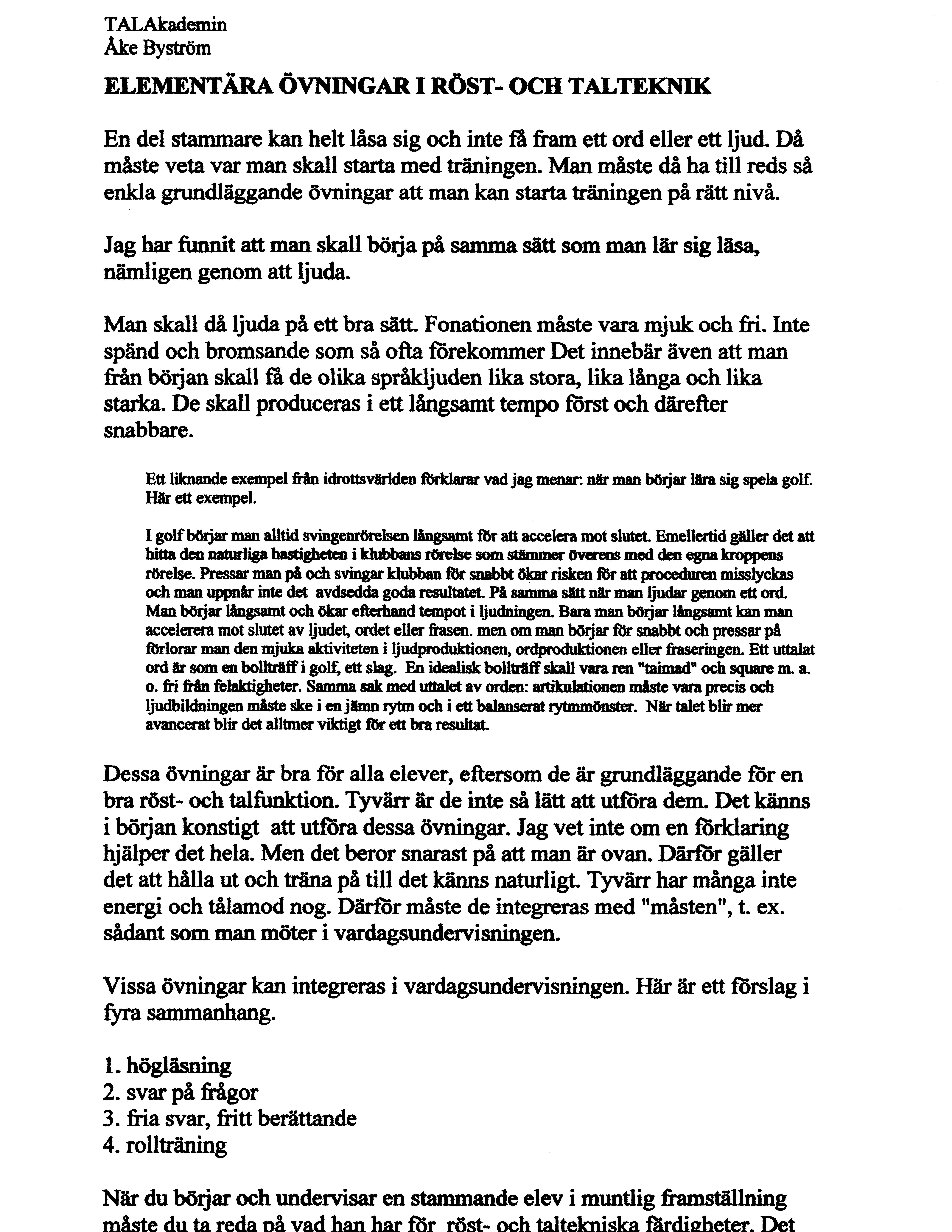
Elementära övningar i röst- och talvård

Scannade texter 2014 .övningar i röst- och talteknik

Är det här ett exempel på NLP? Jag tror det.

För att citera en av mina närmsta vänner: ”Du stammar mycket bättre nu!” Hon menade dock att jag stammade mindre och hade bättre flyt. För ungefär 6 månader sen. Roas fortfarande av den kommentaren.
(klipp från facebook)

Låt oss lära av varandra…

2013-11-03

”…Att se bilden när Per Alm sätter elektroder i ansiktet på en stammande ger blandade känslor. Positivt är att man upplever honom som en riktig forskare. Men det känns inte lika rätt att sätta elektroder på stammande för att mäta vad de gör när de stammar. Fråga Stig Lindh, lekmannaforskaren som i tycker att Per Alm borde inrikta sin forskning på hur normaltalande människor gör när de talar. Eftersom han kan behöva en kontrollgrupp kan det vara lämpligt att det är stammande personer som intar den rollen.”

(Ur Stig Lindh: Nyhetsbrev, 2013-11-03

Kommentar:
Mycket bra förslag, tycker även jag. Jag har länge undrat varför man inte tar till vara de stammandes erfarenheter av att bli flytande i sitt tal. De finns en hel del personer som jag känner personligen som skulle kunna berätta. Jag har nämligen själv frågat dem. Så jag vet vad de har svarat. Det torde nu vara rätt tid för en sådan publicering.

I ett mail från Alan Badmington har jag saxat följande:
2013-11-04

”I frequently express the view that we can all learn something (however small) from each other’s stories. Reading about the lives of other PWS/PWB can provide an interesting insight into how they deal (or have dealt) with their respective difficulties, as well as offering reciprocal inspiration.

It can alert us to possibilities of which we were previously unaware – in relation to therapies, techniques and opportunities that allow us to unearth our true potential. It can also open our eyes to possibilities that we could never have imagined, igniting belief in our own capabilities.

When we become aware of the challenges/roles undertaken by others, it can encourage us to emulate their actions and confront obstacles in our own lives.

Learning about a PWS/PWB who successfully embraced public speaking had a huge impact upon my self-concept. Until that moment (in 2000), I truly believed that such a role lay outside the scope of someone who stuttered. I was inspired by his activities and wanted to follow his example. That fortuitous occurrence sowed the seeds of an empowering belief that was to subsequently change the course of my life.

Thank you, once again.
Kindest regards
Alan

Kommentar:
Låt oss nu äntligen i TALAkademin samla in berättelser från oss alla medlemmar i svenska stamningsföreningar där vi lärt oss att tala bättre och bättre trots vår stamning av lika eller varierande slag. Det kommer att inspirera till efterföljd. Prövat och erfarit är en bra avslutning på en sådan berättelse.

Hur mycket behöver jag träna?

I guess I became desensitized (in relation to my communication issues) by routinely placing myself in situations that generated fear or discomfort. I consciously commenced such a proactive approach in 2000 when I decided to make a concerted effort to confront my fears. With hindsight, I now realize that I had made considerable inroads into reducing my levels of anxiety during the preceding 20 years (when I wore a small prosthetic device known as the Edinburgh Masker).

It became my mechanical crutch, allowing me to keep my head above water in my darkest hours. Although the electronic machine never made me fluent, it gave me the confidence (under the umbrella of the masking sound) to speak in situations that I know I would, otherwise, have avoided (particularly while on police duties).

As a result, I acquired very useful interpersonal skills which many PWS (quite understandably) do not possess because they tend to remain on the fringes of conversation. Conversely, `fluent’ people generally develop these skills progressively from an early age. The fact that I had attained a high degree of proficiency in the art of chit chat/small talk proved invaluable when (13 years ago) I chose to challenge my restrictive beliefs and embark upon a more expansive lifestyle.

I think it is important to clarify the point that I gained the expertise to engage in meaningful oral conversation (with others) MANY YEARS before I acquired greater fluency. Yet, I did not appreciate that I possessed such skills until I had occasion to spend a protracted period in the company of a large group of other PWS/PWB (for the very first time in my life). This occurred when I attended my initial McGuire course (and subsequent support groups) in 2000.

Although many of those present (having been equipped with certain physiological tools/techniques) could amply demonstrate that they were able to speak well in those controlled environments, their conversational skills (in a social situation) remained limited. Please be assured that these comments are not intended to be disparaging, I’m simply making an observation. As with any skill, we do not become proficient overnight, we need to perform that specific task repeatedly.

Over the years, I have facilitated several active workshops on this very subject. I feel that many PWS/PWB could benefit from gaining greater proficiency in this important area of communication.

Bob, I’m sorry it’s taken me a few days to respond but I have not had an opportunity to scrutinze my posts during recent days.

Kindest regards
Alan

Det här inlägget av Alan Badmington tycker jag väl illustrerar hur mycket man behöver träna för att nå framgång. Vi är alla olika och var och en måste själv ta reda på hur mycket träning man behöver lägga ner för att nå fram till ett visst mål. Alan B nämner för sin del att det för honom har tagit flera år. Så har det varit även för mig. Flera år!!! Det låter kanske avskräckande. Det skulle det ha gjort för mig om jag fått veta i förväg hur många år jag själv har behövt träna mitt tal för att det skulle bli märkbart bättre. Därför måste träningen göras lustbetonad. Det måste vara kul att träna. Att åstadkomma lockande träningsvillkor är en angelägen uppgift för alla stamningsföreningar. Det upptäckte vi i TALAkademin. Vi ordnade därför olika event som lockade till träning på olika sätt med syfte att förbättra vår muntliga framställning. Det gäller att hålla ut. Att vara uppfinningsrik. Att ha kul tillsammans i en stamningsförening. Gärna samverka med andra stamningsföreningar. I Sverige och även utomlands.

Träna tillsammans med personer som stammar från hela världen

The Royal College of Speech & Language Therapists currently recommends ‘talking therapies’ such as Cognitive Behaviour Therapy (CBT) to treat social anxiety in people who stutter. Although CBT and similar approaches can offer effective treatment for social anxiety in this client group, people who stutter may be reluctant to receive treatment that requires them to have lengthy spoken conversations with a therapist, because if their social anxiety is associated with their speech problem they will, by definition, dislike speaking.
In the present study we are piloting an online treatment that has been used successfully to treat social anxiety in people who do not stutter. Participants will be randomly allocated to a treatment or placebo condition, and carry out eight 20-minute computer sessions over a 4-week period, either at home or at the University of East Anglia. Immediately before and after the 4-week treatment period, and again 4 months later, researchers will measure participants’ levels of social anxiety and speech fluency.
This study aims to evaluate the feasibility of this approach and its acceptability to people who stutter. The results of the study will be used to strengthen the design of a more comprehensive trial.
For further information, please contact j.mcallister@uea.ac.uk .

Jag läste mina e-mejl idag. Det var många som hade inkommit under de dagar som jag varit i Stockholm. Via ett av Alan Badmingtons e-brev kom jag att slutligen hamna på BSAs hemsida. Jag kopierade därför ovan ett – som jag tycker – intressant inlägg som jag stötte på med rubriken Communications Research Group.

Jag tycker att vi som stammar skulle passa på att delta I andra länders arbete med stamningsrelaterad ängslan och oro och I likhet med Alan Badmongton utvidga vår “confort zone”på olika sätt. Ett bra sätt tycker jag är att ta chansen att delta i ett forskningsprojekt som t. ex. ovanstående klipp berättar om.

Vad talträning ofta kan innebära

The strategies that I have employed (for eliminating avoidances; taking
charge of my thoughts; expanding comfort zones; attaining personal growth;
changing my mindset; challenging self-limiting beliefs and widening my
narrow self-concept) appear to provide encouragement for others (totally
unrelated to stuttering) to deal with their own problems.

”…o deal with their own problems…”
Det som jag i början trodde var unikt viktigt att bli medveten om just därför att man stammar är det inte i själva verket. Enligt Alan Badmington (citatet ovan) gäller det ovan uppräknade för normaltalande lika väl som den som stammar. Visserligen påpekar Alan Badmington, att allt vad han skriver om om stamning och hur han kommit till rätta med talet gäller för honom själv. Det innebär inte automatiskt, att det även gäller för andra eller alla som stammar. Många gånger har han påpekat detta. Därför behöver man kanske inte lära sig allt som Alan Badmington lärt sig. Men kanske något kan man som enskild person som stammar ta till sig och ha nytta av. Kolla gärna och skriv och berätta om det som du kommer fram till i jämförelse med Alan Badmingtons erfarenheter.

Att vara en förebild för andra

It’s one thing to get by without stuttering. It’s another to enjoy giving inspired talks to appreciative audiences. You demonstrate what recovery from stuttering is really all about.
You’re a great role model and inspiration for everyone on this list.
Regards,
John

Före John C. Harrisons kommentar ovan läste jag ett inlägg av ”Anna”. Hon hade just berättat om sin talutveckling under 4 år med träning enligt NLP. Hon upplevde utveckling och framgång med sin person och sitt tal. Trots detta konstaterande erfor hon mycket invändningar och skepsis mot NLP-övningarna från sin omgivning. Så mycket kritik från stamningskretsar, mottog hon, att hon nu övervägde att lämna stamningsvärlden och ägna sig åt folk som önskar träning i muntlig framställning i stället. John Harrison föreslår emellertid att hon behövs som ”role modle” för oss som stammar. Jag instämmer .

Himla kul träning

”The very thought to control stuttering is misleading
and it is actually going against stuttering. Speech is something
which you have to allow to flow and not something to control. ”
If you get that, you’re half way there.
John  (klipp från internet)

Utmaningen är fortfarande att arrangera träning som ger flyt i talet. Den utmaningen har vi sannerligen för länge sedan antagit inom TALAkademin. Men det gäller att utveckla träningen till att bli ”himla kul” för den som fortfarande pockar på det.
Mitt förslag är att alla medlemmar i TALAkademin bidrar med några rader om hur vi kan tänkas göra. Skriv in det på TALAkademins hemsida. Så snart som möjligt!

”Hesitating: Realising that Everyone Stumbles”


”If you know that your speech is hesitent and want to do something about it, take the following first steps.”


  1. Think more clearly.
  2. Slow down your speech and speak with more emphasis.
  3. Master good breathing.
    (sid 236 Voice & Speaking Skills for DUMMIES. 2012)


Upprepningsövningen som vi i TALAkademin brukar använda oss av tränar enligt min mening upp tänkandet, som jag vill beteckna som formuleringsförmågan i det här sammanhanget. Vi kan när som helst utvärdera resultatet. Min hypotes är att tänkandet/formuleringsförmågan kan tränas upp märkbart efter 50 övningar.


Att sakta ner talet tränar vi inom TALAkademin genom att träna på övertydlig artikulation. En skärpning av uttalet minskar taltempot. Det har vi redan bevisat för varandra inom vår förening. Effekten märks direkt.


Att behärska en god andning tränar vi inom TALAkademin genom att tala med viloandningsrytmkänslan. Det fordrar full förståelse och en hel del träning innan man når fram till ett nöjaktigt resultat. En utvärdering av träningsinsatsen kan göras när som helst man önskar.  Min hypotes är att man måste träna minst 3 gånger så mycket som man i förstone tror.


SWITCH

SWITCH innehåller bl a följande sceneri: En ryttare, en elefant, en väg och ett mål. Själv är man elefantens ryttare sittande på elefantens rygg – och som styr, tänker, beslutar. Elefanten represeterar känslorna som kan ställa till problem när man vill åstadkomma en förändring. Det gäller för ryttaren att kunna handskas med elefanten – som kan vara hur bångstyrig som helst – för att få den att gå på vägen fram mot målet. Man måstedärför lära sig att förstå elefanten och handskas med den. Det kan man göra genom att förstå de många olika exempel på lösningar till förändring som boken innehåller. Jag tror att flera exempel kan appliceras på talet och talsvårigheter. Förmodligen också stamning av olika kännetecken. Det är det som jag tror har inspirerat Göran Hjertman. Det ska bli kul att höra vad han kommer att säga under TALA I SKÅNE i början av maj. 🙂